
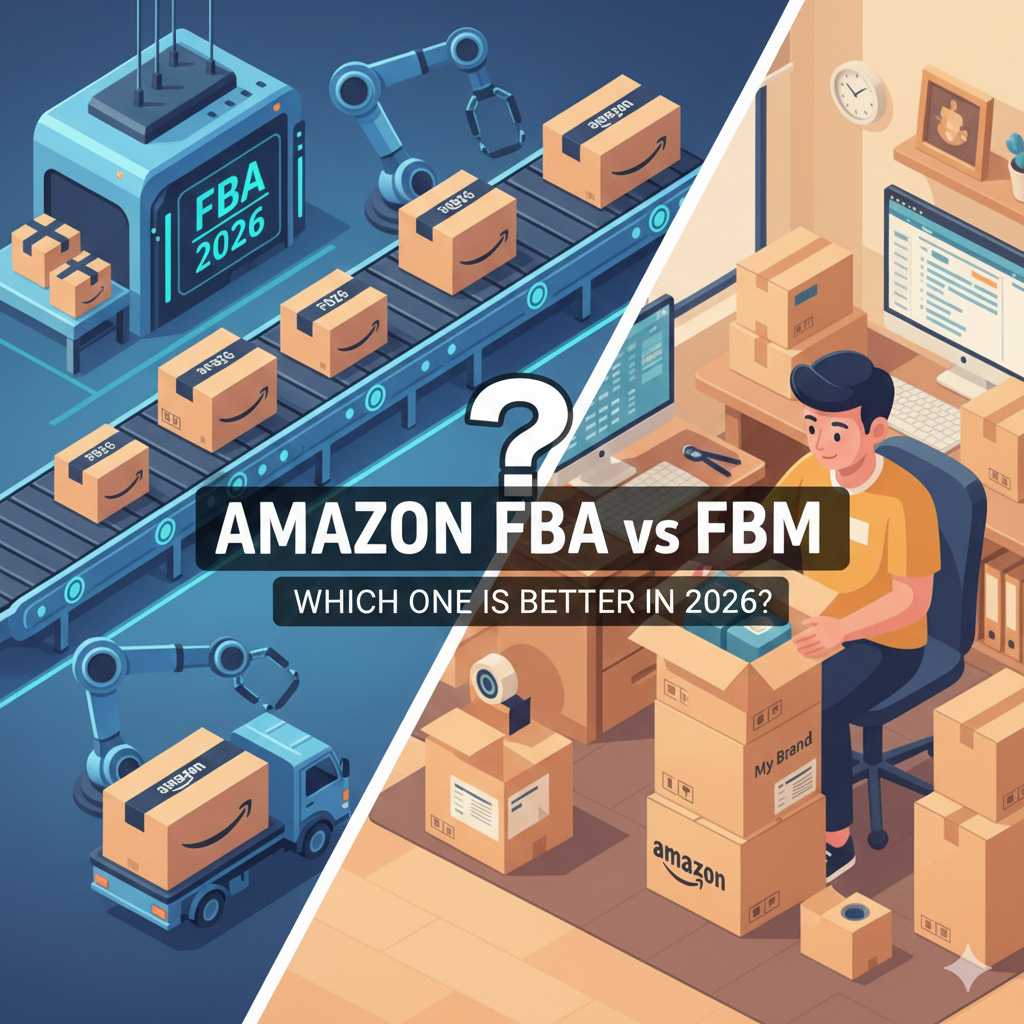
Selling on Amazon in 2026 is more competitive than ever. Rising fees, stricter performance metrics, and smarter buyers mean sellers must make strategic decisions from day one. One of the most critical choices is deciding between Amazon FBA (Fulfilled by Amazon) and Amazon FBM (Fulfilled by Merchant). While both fulfillment models can be profitable, the better option depends on your business model, product category, and long-term goals.
Understanding how each system works and how Amazon has evolved in recent years is essential before committing to either approach.
Understanding Amazon FBA in 2026
Amazon FBA allows sellers to outsource logistics entirely to Amazon. After sending inventory to Amazon’s fulfillment centers, Amazon takes responsibility for storing products, packing orders, shipping to customers, managing returns, and handling customer service. For many sellers, especially beginners, this hands-off approach remains one of the biggest attractions of FBA.
In 2026, FBA continues to offer significant advantages in terms of visibility and trust. Products fulfilled by Amazon are automatically eligible for Amazon Prime, which plays a major role in purchase decisions. Prime customers expect fast and reliable delivery, and listings with the Prime badge often convert at a much higher rate than non-Prime offers. Amazon’s algorithm also tends to favor FBA listings when competing for the Buy Box, making it easier to generate consistent sales.
However, FBA has become more expensive over time. Storage fees, fulfillment fees, and additional surcharges have increased, especially for long-term or slow-moving inventory. Amazon has also tightened inventory limits, forcing sellers to plan stock levels carefully. While FBA still offers unmatched convenience and scalability, profit margins can shrink if fees are not monitored closely.
Understanding Amazon FBM in 2026
Amazon FBM gives sellers complete control over their fulfillment operations. Instead of using Amazon warehouses, sellers store inventory themselves or use third-party logistics providers. They handle packing, shipping, customer communication, and returns, while Amazon acts solely as the sales platform.
In 2026, FBM has become increasingly popular among experienced sellers who prioritize flexibility and cost control. Without Amazon’s storage and fulfillment fees, FBM can be significantly more profitable for certain products, especially oversized items, low-margin goods, or products with unpredictable sales volume. Sellers also gain full control over packaging, branding, and shipping methods, which is particularly valuable for brand-focused businesses.
That said, FBM comes with added responsibility. Sellers must maintain fast shipping times, manage customer service efficiently, and meet Amazon’s strict performance standards. Late shipments or poor customer feedback can quickly damage account health. Additionally, FBM listings do not automatically receive the Prime badge, which can reduce conversion rates unless the seller qualifies for Seller-Fulfilled Prime.
Key Differences Between FBA and FBM in Practice
The most noticeable difference between FBA and FBM lies in who controls the fulfillment process. With FBA, sellers trade control for convenience, while FBM offers control at the cost of operational complexity. In 2026, this trade-off has become even more important as Amazon continues to prioritize customer experience above all else.
FBA sellers benefit from Amazon’s world-class logistics network and customer trust, but they must accept standardized processes and higher fees. FBM sellers enjoy flexibility and potentially higher margins, but they must invest in reliable logistics systems and customer support to compete effectively.
Another major difference is scalability. FBA makes it easier to scale quickly because Amazon handles increased order volume without additional effort from the seller. FBM scaling, on the other hand, requires careful planning, warehouse capacity, and often third-party logistics partners.
What Has Changed in 2026?
Compared to previous years, Amazon in 2026 places more emphasis on efficiency and profitability. FBA fees are higher, inventory storage rules are stricter, and sellers are expected to optimize operations continuously. At the same time, Amazon has improved Seller-Fulfilled Prime requirements, making it possible for FBM sellers to compete more effectively if they can meet fast delivery standards.
As a result, many sellers are moving away from a single-fulfillment strategy. Instead of choosing only FBA or only FBM, businesses are increasingly adopting a hybrid approach to balance cost, control, and performance.
Which Fulfillment Model Is Better in 2026?
There is no universal answer to whether FBA or FBM is better in 2026. For sellers focused on rapid growth, automation, and high conversion rates, FBA remains a powerful option. It is particularly effective for small, lightweight, fast-moving products where Amazon’s fees are offset by higher sales volume and better visibility.
FBM is often the better choice for sellers who value control and margin optimization. It works well for large or fragile products, brands that require custom packaging, and businesses that already have fulfillment infrastructure in place. FBM also makes sense for sellers operating across multiple sales channels, as it allows centralized inventory management.
For many established sellers, the most effective solution is a hybrid model. By using FBA for best-selling or highly competitive products and FBM for slower-moving or high-cost items, sellers can maximize profitability while maintaining flexibility.
Final Thoughts
In 2026, the debate between Amazon FBA and FBM is less about choosing one over the other and more about choosing the right strategy for your business. FBA offers convenience, trust, and scalability, while FBM provides control, flexibility, and potential cost savings. The most successful sellers are those who understand their numbers, adapt to Amazon’s changing rules, and choose a fulfillment model that aligns with their long-term goals.
Ultimately, the better option is the one that supports sustainable growth, healthy margins, and a strong customer experience in an increasingly competitive Amazon marketplace.